
Shopify Chargebacks: How to Prevent Them and Win Disputes
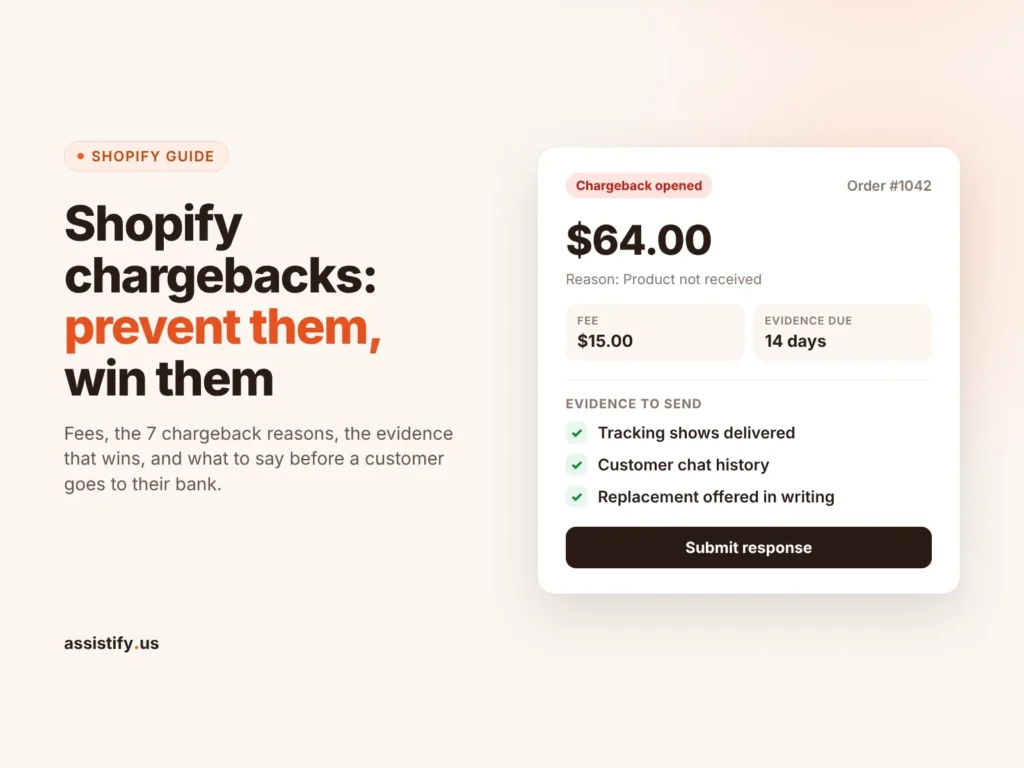
A Shopify chargeback happens when a customer asks their bank to reverse a payment instead of asking you for a refund. With Shopify Payments, the order amount and a chargeback fee ($15 in the US) leave your balance straight away, and you only get them back if you win. Most chargebacks start as a customer question that nobody answered, so fast, clear customer support is the cheapest chargeback prevention there is.
This guide covers what a chargeback costs on Shopify, why customers file them, how to prevent each type, and how to respond and win the ones you can’t prevent. It’s written from the support side: what to say to customers before a dispute happens, and what to send the bank after.
What is a chargeback on Shopify?
A chargeback is a forced refund. The customer contacts their card issuer, says something is wrong with a payment, and the bank pulls the money back from you while it investigates. You don’t get a say before the money leaves. You get a chance to respond with evidence afterwards.
Shopify separates two kinds of dispute (Shopify Help Center):
- A chargeback: the disputed amount and the fee are taken from your payout immediately. If the customer wins, you lose both.
- An inquiry: the bank asks questions first, and no money is taken yet. If it closes in your favour, nothing happens. If it closes in the customer’s favour, it can turn into a chargeback.
Treat an inquiry as your early warning. It’s the cheapest moment to sort the problem out, often with one honest email to the customer.
What a Shopify chargeback costs
The fee depends on the currency you’re paid out in, not where the customer lives. These are the amounts Shopify lists for Shopify Payments:
| Payout country | Chargeback fee |
|---|---|
| United States | $15 USD |
| United Kingdom | £10 GBP |
| Australia | $25 AUD |
| Japan | ¥1,300 JPY |
| Mexico | $200 MXN |
If you win, Shopify returns the disputed amount and the fee. If you lose, both are gone. And the fee is the small part. On a lost $80 order you also lose the product you shipped, the shipping cost, the time spent building a response, and some trust with your payment provider. A store that collects too many chargebacks can face holds on its payouts, so it pays to keep the number low even when each one is small.
Why customers file chargebacks
Shopify groups chargebacks by the reason the bank gives. In real stores, those reasons usually trace back to a handful of everyday problems:
- They didn’t recognise the charge. The name on their bank statement didn’t match your store, so they assumed it was fraud.
- The order was late or “lost”. They couldn’t get an answer about where it was, so they asked the bank instead.
- The product wasn’t what they expected. Wrong size, different colour, damaged in transit, or the description oversold it.
- The refund didn’t show up. You approved a return, but the money took longer than they expected, or nobody confirmed it.
- They couldn’t cancel. A subscription renewed and they couldn’t find a way to stop it.
- Real fraud. Someone used a stolen card, and the real cardholder disputed it.
Only the last one is true fraud. The rest are customers who felt ignored or confused. That’s why chargeback prevention is mostly a customer service job, not a software job.
How to prevent chargebacks on Shopify
These are the changes that stop most disputes before they start. Shopify’s own guide to preventing chargebacks makes the same points: be easy to reach, answer quickly, be clear about your policies and keep customers updated.
1. Use a billing descriptor customers will recognise
The billing descriptor is the text that shows on the customer’s card statement. If your store is called Willow & Thread and the statement says “WT HOLDINGS LLC”, expect “unrecognised charge” disputes. Set it to your store name or website in your Shopify Payments settings, and keep it the same everywhere your customers see your brand.
2. Make your contact details easy to find
Customers file chargebacks when going to the bank feels easier than reaching you. Put an email address and a live chat button on every page, add a contact link to your order confirmation and shipping emails, and say how fast you reply. “We reply within an hour, 9 am to 5 pm Eastern” stops a lot of panic.
3. Answer every message within hours, not days
This is the single biggest lever. A customer who writes “where is my order?” and hears nothing for three days is the customer who files “item not received”. Answer quickly, even if the answer is “I’m checking with the carrier and will update you by 3 pm”. Our where is my order email templates give you six ready replies for exactly this moment.
4. Send tracking and keep customers updated
Send the tracking number as soon as the order ships, and tell customers about delays before they notice. A short “your order is running two days late, here’s the new date” email is far cheaper than a dispute.
5. Write product pages that set the right expectations
Use real photos, give exact measurements, and add a size guide. If a colour looks different in person, say so. Most “not as described” disputes come from a gap between what the page promised and what arrived.
6. Make your return policy clear and refund fast
A visible, simple return policy turns “I want my money back” into a return request instead of a chargeback. Once you approve a refund, process it straight away and email the customer to say when it will reach their account. If you need a starting point, use our return policy template for Shopify.
7. Make subscriptions easy to cancel
Explain the recurring charge clearly at checkout, send a reminder before each renewal, and cancel the same day a customer asks. Then confirm the cancellation in writing.
8. Screen risky orders before you ship
Shopify flags orders with high fraud risk. Review those before fulfilling. Look for a billing and shipping address in different countries, several failed card attempts, or a rush shipping upgrade on a first order. For orders shipping to the US, UK or Canada, Shopify suggests holding orders that fail the address check (AVS) and contacting the customer before shipping.
9. Use Shopify Protect where it applies
Some Shop Pay orders are covered by Shopify Protect, which reimburses eligible fraud-related chargebacks. You can see whether an order is protected in its order details. It doesn’t cover disputes like “not as described” or “credit not processed”, so it’s a safety net for fraud, not a full solution.
10. Refund before it becomes a dispute
If a customer is angry and the order is small, a quick refund often costs less than fighting. A refund costs you the order. A lost chargeback costs you the order, the product and the fee. When a customer says they’re going to their bank, pause and work out which outcome is cheaper.
What to say when a customer threatens a chargeback
These are the moments where a good reply saves the sale. Use them as a starting point and change the details to fit the order.
When they don’t recognise the charge:
Hi Maria, thanks for checking with us first. The charge of $64.00 on 3 November is for your order #1042 from Willow & Thread, a linen shirt in size M. It shows on your statement as “WILLOWTHREAD.COM”. If you didn’t place this order, reply here and we’ll cancel it and refund you today.
When the order is late and they mention the bank:
Hi James, I’m sorry your order still hasn’t arrived. I’ve checked the tracking and the parcel has been at the local depot since Tuesday. I’ve opened a trace with the carrier and will update you by 3 pm tomorrow. If it isn’t moving by Friday, I’ll send a replacement or refund you in full, whichever you prefer. You won’t need to go through your bank for this.
When the product wasn’t what they expected:
Hi Priya, thanks for the photos. That colour isn’t how it should look, and I’m sorry. I can send a replacement today or refund you in full. You don’t need to post the item back. Just tell me which option you’d like.
When they’re waiting for a refund:
Hi Tom, your refund of $48.00 was processed on 5 November. Banks usually take 5 to 10 business days to show it. Here’s the refund reference in case your bank asks: RF-2231. If it hasn’t appeared by 19 November, reply here and I’ll chase it with our payment provider.
Notice the pattern: a specific answer, a specific date and a clear next step. That’s what stops a customer from going to the bank. If emotions are already high, our guide on how to handle angry customers has scripts for calming things down first.
How to respond to a Shopify chargeback
When a chargeback arrives anyway, Shopify emails you and shows the dispute in your admin with a due date. You usually have 7 to 21 days to respond. With Shopify Payments, order information is added for you, and a response is submitted on the due date even if you add nothing. The bank can then take up to 75 days to decide.
- Open the dispute in your Shopify admin and read the reason. The reason decides what evidence matters.
- Check the order history. Look at the customer’s messages, the tracking, any refunds already given and any returns started.
- Decide whether to fight or accept. If the customer is right, for example the item never arrived and the tracking proves it, accept and move on. Fighting a dispute you can’t win just adds work.
- Contact the customer. Sometimes they filed by mistake, or a family member made the purchase. A customer can ask their bank to withdraw a chargeback.
- Gather evidence for the specific reason using the table below.
- Write a short, factual summary. One paragraph: what was ordered, when it shipped, when it was delivered, and how you tried to help. Banks read a lot of these, so make yours easy to scan.
- Submit before the due date. Once you submit, you can’t change your response, so check it first.
Evidence that wins each type of chargeback
| Chargeback reason | What the customer is saying | Evidence to send |
|---|---|---|
| Fraudulent | “I didn’t make this purchase.” | Matching billing and shipping address, AVS and CVV results, delivery confirmation, any past orders from the same customer, and messages they sent you. |
| Unrecognised | “I don’t know what this charge is.” | Order confirmation email, your billing descriptor, and proof of delivery. Many of these are withdrawn once the customer remembers the order. |
| Product not received | “It never arrived.” | Tracking showing delivery to the customer’s address, a delivery photo or signature if you have one, and your messages offering help. |
| Product not as described | “It’s not what I ordered.” | The product page as it looked at the time of purchase, photos of the item, your return policy, and proof you offered a return or replacement. |
| Credit not processed | “I was promised a refund.” | Proof of the refund with its date and amount, or your return policy showing why a refund wasn’t due. |
| Subscription cancelled | “I cancelled and was still charged.” | The terms shown at sign-up, renewal reminder emails, and a record showing no cancellation request before the charge. |
| Duplicate | “I was charged twice.” | Proof that the two charges were for two separate orders, or proof that you already refunded the second one. |
Your customer service history is often the strongest evidence you have. A chat where the customer confirmed the size, or an email where you offered a free replacement, shows the bank you acted in good faith. That only works if every conversation is logged on the order, so make sure whoever answers your customers saves them in your help desk.
Keep an eye on your chargeback rate
Your chargeback rate is the number of chargebacks divided by the number of orders over a period. With Shopify Payments, you can see it in your Shopify analytics. Check it monthly. A sudden rise usually points to one cause: a carrier problem, a product that photographs differently, or a support inbox that fell behind during a busy week.
Card networks watch merchants with high dispute rates, and the exact thresholds vary by network and payment provider. You don’t need to memorise them. If you follow the steps above, most small stores stay well clear.
Chargebacks get worse in peak season
November and December bring more orders, more delayed parcels, more gift purchases the cardholder doesn’t recognise, and slower support replies. That’s the perfect mix for disputes, and many of them land in January. Before the rush, write your ready answers for late orders and refund questions, and make sure someone covers your inbox every day. Our Black Friday customer service plan walks through it week by week.
Frequently asked questions
What is a chargeback on Shopify?
It’s when a customer disputes a payment with their bank instead of asking the store for a refund. The bank takes the money back from your Shopify balance while it reviews the case, and you can respond with evidence.
How much is the Shopify chargeback fee?
For Shopify Payments it’s $15 in the US, £10 in the UK and $25 AUD in Australia. Other countries have their own amounts. You get the fee back if you win.
How long do I have to respond to a Shopify chargeback?
Usually 7 to 21 days. Shopify shows the exact due date on the dispute. The bank can then take up to 75 days to decide.
Does Shopify protect sellers from chargebacks?
Partly. Shopify Protect covers eligible fraud-related chargebacks on some Shop Pay orders. It doesn’t cover disputes about late, damaged or wrong items, refunds or subscriptions.
Can I win a chargeback if the customer received the item?
Often, yes. Delivery confirmation, your order emails and your conversation history are strong evidence, especially for “not received” and “unrecognised” disputes.
Should I refund a customer who threatens a chargeback?
If the order is small or the customer has a fair point, a refund usually costs less than a lost chargeback. If the order is large and you have clear evidence, respond calmly, offer a fair solution in writing and keep the conversation on file.
Can a customer cancel a chargeback?
Yes. A customer can contact their bank and withdraw the dispute, which often happens with unrecognised charges once they remember the order.
The short version
Most Shopify chargebacks are a customer service problem in disguise. Use a billing descriptor people recognise, answer every message quickly, send tracking and delay updates, refund fast, and keep every conversation on the order. When a chargeback does arrive, match your evidence to the reason and submit before the due date.
If your inbox is the part that keeps slipping, that’s what we do. A dedicated Assistify agent answers your email support and live chat under your brand name, within the hour, so customers get answers before they think about their bank. See our pricing, compare it with typical customer service outsourcing costs, or book a 20-minute call.
About the author. Saif Sheikh has worked in customer support since 2017. He started in an in-house support job, saw that online stores needed a better option, and went freelance. Since then he has led a team of 22 people, supported more than 100 brands and trained many newcomers, free of charge, to start their own freelancing careers. More about Assistify.